Financial spread betting is a particularly useful speculative tool in fast-moving markets. Not only does it allow you to enter and exit trades quickly but it also provides you the opportunity to profit even when financial markets are moving down in value.
The financial crisis has certainly resulted in a market increase in volatility across all asset classes. As the Euro currency reaches a 16-month low against the Dollar, the eurozone crisis persists, leading to bearish trading on the EUR/USD currency pair. Spread traders love volatility as they look to profit from daily price swings and as a result trading volumes have continued to soar. And certainly the persistent volatility has attracted more and more people to try their hand at this alternative means of speculating the financial markets than ever before. In the last year most companies have witnessed huge volume increases across the three main product classes: shares, indices and forex trading.
Most brokers agree that traders will deal more actively in volatile conditions, even if they are not always successful.
Unlike risk-average investors traders live for volatility. The potential to make money whether the market is going up or down is certainly attractive in the present environment, and that’s what spreadbets offer. Spread trading companies note that trading volumes normally rise as market volatility increases. As volatility increases, so does the number of trades as investors tend to trade more actively in turbulent market conditions, even though they aren’t always successful.
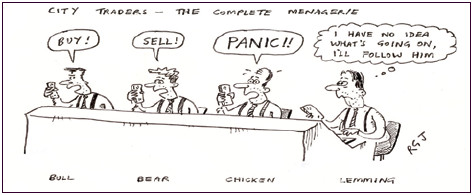
What is interesting is that index trading is prone to attracting the most deals during such times; clients are reluctant to speculate on individual equities and tend to focus more on indices like the FTSE 100 or Wall Street. Of course currency trading also remains popular. We don’t trade the economy, but we can profit from shorting the indices. If there’s no money in the economy companies can’t grow, investors don’t want to invest, PE ratios fall and we traders find it difficult to make money, we become extremely cautious, selective and nervous, which causes volatility. We have never experienced globalisation before, the poor in the East are sucking the cash and economic growth from us in the West. Forget the Elliot wave, we’re gonna need an Elliot Tsunami to bring it back, and it aint going to happen in our lifetime.
These are difficult markets in which to pick one direction and go in that direction for any length of time. In such markets when one doesn’t have any scruples trading up and down fortunes can be made. We are lucky that we can spin the roulette wheel and with educated analysis make sound investments either long or short with suitable and sufficient stops in place to prevent us losing a significant amount of our hard earned.
Why Spread Bet on a Volatile Market?
The stock markets can be quite scary at present so why would small private traders take on the additional risk of margin traded products? The answer is that spread betting as a trading instrument is not as terrifying as it may first appear, and for the disciplined trader – offers the opportunity for great gains.
The nice thing about spread trading is that you can make money from moving prices, irrespective of the market direction. You just take a trade based on what you believe prices will move in the coming days or weeks. And the best thing about spread trading is that you don’t have to stump up the full capital to buy the market value of the underlying equity – spreadbets being margin-traded products (i.e. leveraged products), you only have to pay for a portion of the total exposure.
Spreadbetters tend to become more short-term in their trading timeframes trying to maximise the opportunities of the bigger market movements. Traders also take profits or losses quicker when markets move a lot. While this increases trading volumes, experienced traders tend to reduce their stake sizes and widen stops to adjust for the increased volatility, maintaining their same risk profile. This way if you get the market direction right, you won’t be stopped out due to turbulent market conditions.
Obviously movements in the financial markets helps to uncover more trading opportunities for spread betters but too much volatility can hurt even the most astute of spread bettors. For one during very volatile periods market gapping can be a problem which means that a market jumps from one level to another, without ever trading in between. In some really volatile times I tried trading in and out of shares to capture the volatility but opening spreads and overall market moves made that profitable on some days and a waste of time on others, so I invoked the plan and ceased trading any stock where I had lost money three times in a row. In this sense volatility is very much a two-edged sword. Much depends on the trades taken by investors and the trade sizes. Volatility does tend to bring attention to the financial markets and financial spread betters are all to ready to take an opportunity to make profits.
The recent volatility has been particularly good for short term traders, though not necessarily a good thing for those with a buy and hold investment philosophy. In any case the ability to go short gives share traders the power to profit from falling markets as well as rising ones and in this respect spread betting is very flexible. However, even though clients always have the ability to trade both long and short, most investors still seem to have a natural bias towards buying positions.
‘Mobile trading is so crucial in today’s volatile markets, meaning that you can keep on top of your trades at any time of the day, regardless of where you are.’
‘We know that the 80% spreadbet losers will sell out on heavy down period because they have the wrong money management or the wrong strategy or the wrong psychology or the wrong timeframe or the wrong stop position. They would have seen the sea of red and been overcome with fear. Many good traders would still be letting profits run, closing longs or taking shorter term short positions but they are the minority not doing what they do out of fear.’
———————————————————————-
Trader’s Rant: Spread Betting these Volatile Markets
The ruthlessness of the market 1 wrong call can do that to you, I’m astonished at the size of stops hedge funds firms use, a lot of the so called geniuses from 08 have lost billions this year; a lot of the time the term hedge fund truly amuses me because I can tell you hedging is something they seem not to do, in my talks with people it basically boils down to if you’re making money they don’t give a **** how you’re doing it – you could be up Ladbrokes all afternoon for all they care!
So day traders get vilified oh it’s impossible to day trade bla bla bla, how on earth are people who trade normally getting on in these markets, just going through a few highly traded stocks, Barclays for example; I can imagine a fair few spread betters bought with the euro news and the break of 200,those with a 10% and 15% stop loss have already being burned with a 20% loss you’re biting your nails, Rio Tinto is a similar story – same again at Antofagasta – all highly traded stocks that Joe Public would be buying, keep on chopping in stocks may keep you out of really big trouble but that’s not how Joe public would trade and even so it’s still eating into your trading pot, unbelievably difficult markets to trade!
Financial spread betting involves taking a position on the movements of financial instruments such as forex pairs, global indices, shares and commodity prices. The bigger the market movement, the bigger the potential gain and this drives traders to trade more to try to make money from the volatility. But the problem is it is very tricky to predict the market direction and how quickly a market is going to move. Sadly most short-term traders who dabble in spread betting fail because they underestimate the effects of volatility and either get stopped out prematurely, or they fail to stick to stop-loss levels.
With asset prices hugely volatile yet returning very little, the ability to speculate, hedge and use the volatility to your advantage makes spread trading an appealing proposition for many, but it is certainly not for the risk-averse of the faint of heart. In certain days it is a minefield trying to call it on a day-to-day basis, being net long or net short, judging which holdings will tank along with the market or will hold up, deciding how much exposure is sensible, all difficult decisions! I probably lose more money when the answer is “it could be either way” than any other time, volatility is a killer, and earning 0% in cash is sometimes better than earning -5% in volatility!